Wednesday, February 1, 2017

Tuesday, January 31, 2017
Calculating the GDP: Expenditures and Income Approach
Expenditure Approach:
C + Ig + G + Xn (export-imports)
Income Approach:
W- Wages (Compensation of Employees/Salaries)
+
R- Rent
+
I- Interest (Money you have to borrow/Money in bank earning interest)
+
P- Profits
+
Statistical Adjustment
Budget Surplus/Deficit:
Government Purchases of Goods and Services + Government Transfer Payments - Government Tax and Fee Collections
+ = Deficit - = Surplus
Trade Surplus/Deficit:
Exports - Imports
+ = Surplus- = DeficitNational Income:
1. Compensation of Employees + Rental Income + Interest Income + Proprietors Income + Corporate Profits
2. GDP - Indirect Business Taxes - Depreciation - Net Foreign Factor Payment
Disposable Personal Income:
National Income - Personal Household Taxes + Government Transfer Payments
Monday, January 30, 2017
Stocks and Bonds/Transfer Payments
Stocks and Bonds: Purely Financial Transactions
- Excluded because nothing is being produced

- Transfer Payments: Money government is transferred to a time where you're going to use it.
- Excluded because nothing is being produced
- Ex: Unemployment, Social Security
Friday, January 27, 2017
Gross Domestic Product & Gross National Product
(Gross Domestic Product): The total value of all final goods and services produced within a country's borders in a given year.
- Includes all production or income earned within the US by the US and foreign producers. It excludes production outside of the US, even by Americans.
GNP (Gross National Product): The total value of all goods and services produced by Americans in a given year.
- Includes production or income earned by Americans anywhere in the world. Excludes production of non-Americans even in the United States.
GDP Formula: C + Ig + G + Xn (exports-imports)
Included in GDP:
- C= Consumption
- Purchase of final goods and services
- 67% of the economy
- Ig= Gross Private Domestic Investment
- Reconstruction of New Housing
- New Factory Equipment
- Factory Equipment Maintenance
- Unsold Inventory of Products Built in a Year
- 17% of the economy
- G= Government Spending
- School Busses
- Highway
- Guns
- 18% of the economy
- Xn= Net Exports
- EXPORTS - IMPORTS
- -2% of the economy because majority is imports
NOT Included in GDP:
- Intermediate Goods (Inputs)
- Ex: Lettuce, Cheese in Sandwich
- Trying to Avoid Double or Multiple Counting
- Used or Second-Hand Goods
- Trying to Avoid Double or Multiple Counting
- Unreported Business Activities
- Ex: Tips
- Stocks and Bonds
- Non-Market Activity
- Ex: Volunteer, Babysitting Without Pay, Work for Self
- Illegal Activity
- Ex: Underground or Black Market
- Gifts or Transfer Payments
- Ex: Scholarships, Social Security, Unemployment, Giving Someone Money
Wednesday, January 25, 2017
Circular Flow
Circular Flow: Represents the transactions within an economy by flows around the circle

- Household: A person or a group of people who share their income
- Firms or Business: An organization that produces goods and services for sale
Thursday, January 19, 2017
Excess Supply and Demand
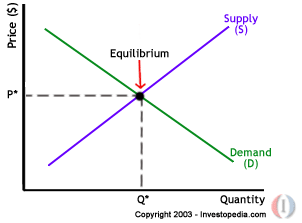
Equilibrium


- The point in which the supply curve intercept with the demand curve
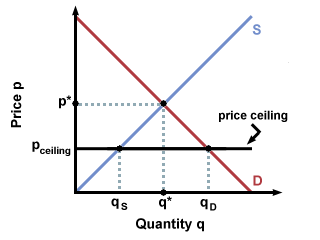
Excess Demand
- Occurs when quantity demanded in greater then quantity supplied
- This will result in a shortage
- Consumer cannot get quantity of the items they want
- Price Ceiling
- When government puts a legal limit on how high the price of a product can be
- Creates a storage
Excess Supply
- When quantity supplied is greater then quantity demanded
- Creates surplus
- Producers have inventory that they cannot get ride of
- Price Floor
- The lowest legal price a commodity can be sold as
- The government use price floor to keep product prices from becoming too low

Thursday, January 12, 2017
Total Revenue
Defintion
- It is the total amount of money a firm receives from selling goods and services
- Product x Quantity
- P x Q
- Make sure you use $$$$$ signs

Subscribe to:
Posts (Atom)